


We’ve all been there. It’s bound to happen in a child’s 15+ years education. A conflict with the school. An IEP that doesn’t feel right. Services that are not being delivered. Emotions can run high, with feelings of frustration, worry and fear that our child’s needs are not being met. SPIN often gets a call from a distraught parent or a concerned teacher, that something is going on at school and they don’t know what to do about it. Below, we’ll share informal and formal dispute resolution options, where you can find local support to grow your advocacy, along with infographics and SPIN Conference workshop slides.
Positions vs. Interests
When trying to resolve conflict, and find common ground between the school and the family, we need to look at Position vs. Interest.
- A position is a particular stance taken by one party in a negotiation. It usually outlines their preferred result.
- Parent: “I want my kid to have 300 minutes of speech therapy every week so they can learn to speak better.”
- School: “That’s just not possible.”
- An interest is the reasons behind the position. Interests define the problem.
- Parent: “I’m afraid my child will be bullied because of their speech. I’m worried they won’t make any friends. I’m concerned they won’t be able to get a job if people cannot understand them.”
- School: If they have an hour of speech therapy a day, they will miss out on other important curriculum and learning opportunities.”
When both sides listen to the position and the interest of each other, there is an opportunity to find a solution. Watch the video on Positions vs. Interest to learn more.
“Unless you are prepared to remove your child from public school forever, you need to view your relationship with the school as a marriage without the possibility of divorce.”
~ One of our favorite quotes from Pete and Pam Wright, of Wrightslaw, an online special education law and advocacy website: https://www.wrightslaw.com/blog/parentschool-relationship-marriage-without-the-possibility-of-divorce/
Informal Dispute Resolution
If you feel like there might be a problem at school or an issue with the delivery of the IEP, the first step is discussing your concerns with the school. Document your communications and follow up with an email to highlight what was discussed. Be kind in your communications. Don’t point fingers and place blame. Use “I feel” statements. Keep the focus on the child. Work up “the chain of command” to give folks a chance to work with you to make things better. At any point in this process, you can ask for an IEP meeting to discuss your concerns with the team and find a solution.
- Contact your child’s teacher – the teacher, either special education or general education teacher, will be the one responsible for providing the educational program and coordinating with aids and other service providers. You can send them an email, or ask for a brief after-school meeting (in person or on Zoom) when you drop off or pick up your child from school – do not unload your concerns on them before school starts or at the end of the day. This will allow you to think over what you want to say and the teacher won’t feel caught off guard.
- Contact the school administration – this could be the Principal, Vice-Principal or School Services Coordinator (SSC). The principal may not have been at your child’s last IEP meeting, but all decisions at the school end with them. If you email the vice-principal or SSC, be sure to cc the principal to keep them in the loop. If you call the school to set up an in-person or virtual meeting, give a brief description of why you are asking for a meeting “I have some concerns about my child’s IEP and I’d appreciate a meeting with the principal”. When you do meet with the principal or other admin, focus on the concern, bring some ideas for a solution and be open to suggestions.
- Contact the District Educational Specialist (DES) – The Hawaii Department of Education is organized in three layers: the school, the district and the state. Your district office has resource teachers (RT) that are specialized in different areas. For special education, they are called the DES. Some DES also specialize in autism or intensive behavior supports. Call or email you DES and talk with them about your concerns with your child’s IEP. You can also invite them to your next IEP meeting, as they have a greater understanding of special education law and they can sometimes release resources available from the district to the school, to support the student. For a list of the district contact phone numbers, click here.
- Contact the Complex Area Superintendent (CAS) – If you have spoken to the principal and DES and still feel your concerns are not being addressed, reach up to the CAS and ask for a meeting.
Formal Protections Under IDEA
For children who have an IEP, there are 3 formalized steps for dispute resolution: 1) Mediation, 2) Special Education Written Complaint, and 3) Due Process. To learn more about each step, see below or visit the Hawaii Department of Education’s Dispute Resolution page here: https://hawaiipublicschools.org/school-services/parent-rights/dispute-resolutions-and-mediations/. You can also contact the Monitoring and Compliance Branch (MAC) to talk about which step might be right for you. Call 808-307-3600 or email them at specialedcomplaints@k12.hi.us.
Step 1: Mediation
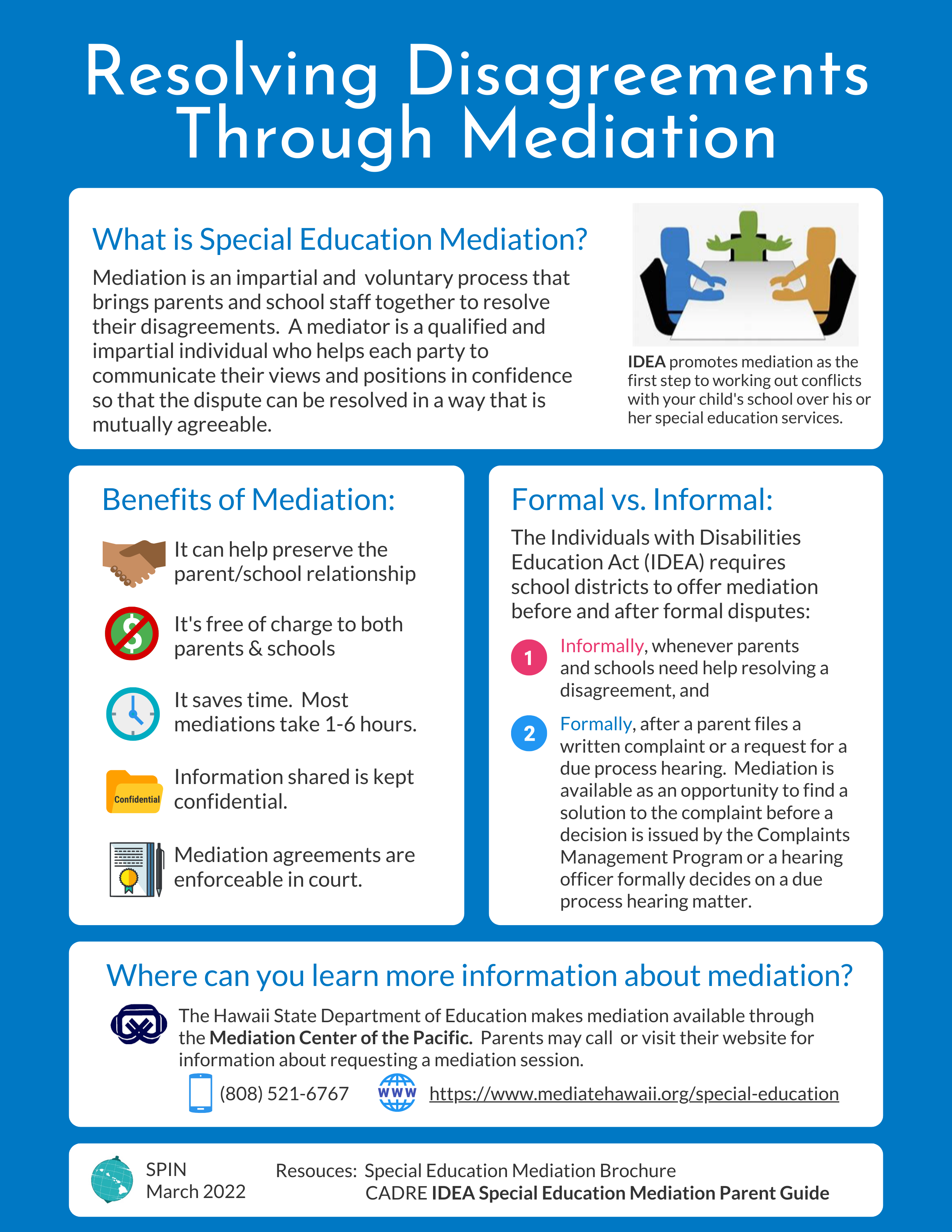
- Mediation is a good first step in conflict resolution.
- It allows both parties to be heard
- It is a free service to both school and families
- Mediation is up to 6 hours and can be broken into 2 or 3 smaller sessions
- Both parties have to agree to mediation
If you would like to try mediation, the HIDOE encourages you to contact the Mediation Center of the Pacific (MCP) to request mediation with your school. They will contact the school, and if they agree, MCP will set up the meeting.
Mediation Center of the Pacific: 808-521-6767 or email: mcp@mediatehawaii.org
You can also fill out a “Request for Mediation: form and email it to MCP. Click here for the form
Step 2: Written Formal Complaint
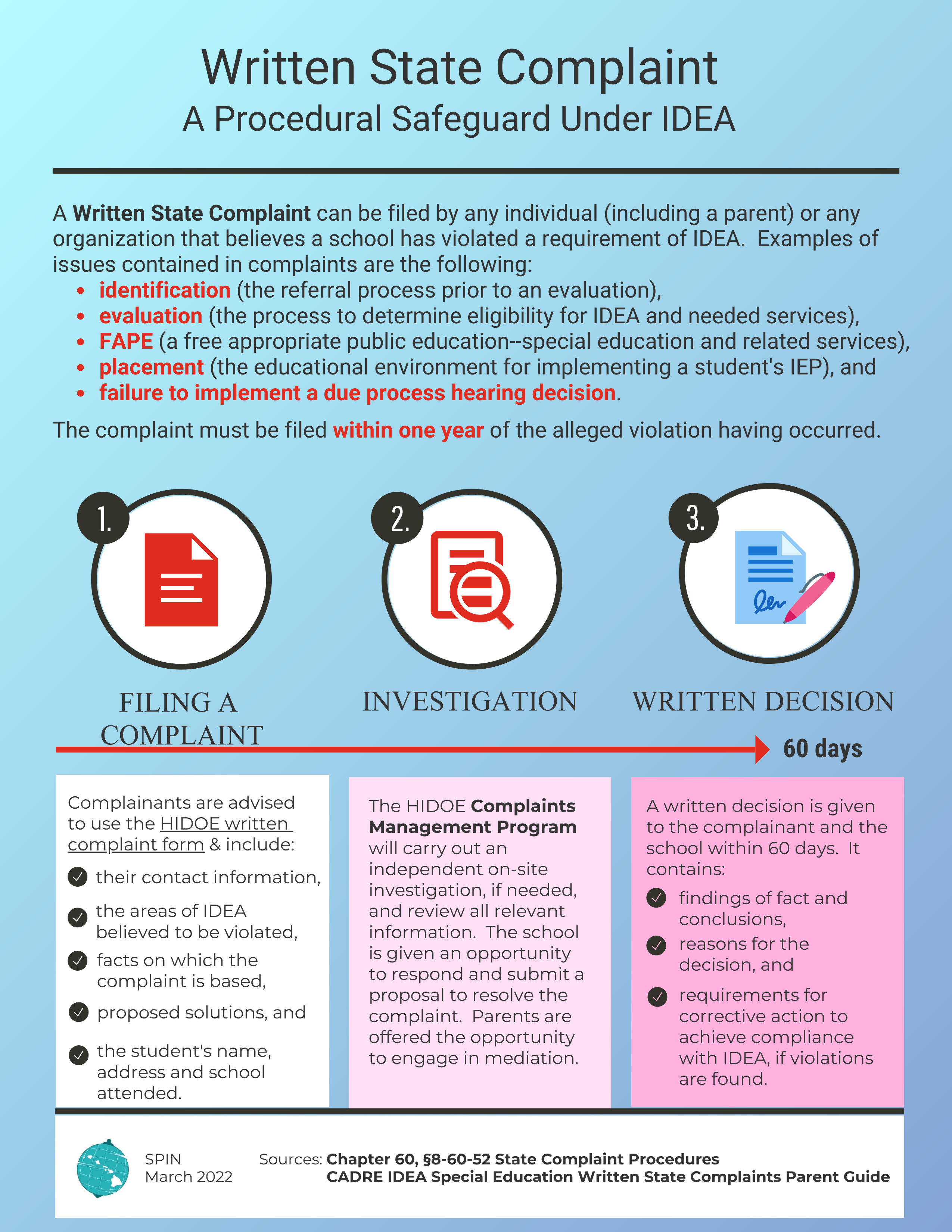
- A written signed complaint can be submitted in writing via email or the US mail. HIDOE has developed a model form that may be used when submitting a written complaint. While using the form is not required, it is recommended the form be used, since it tells you the required components that must be included in a written complaint.
- The Monitoring and Compliance (MAC) Branch is a state-level entity that is responsible for investigating the complaint and redering a decision.
- You can call the MAC office with questions at 808-307-3600
To learn more about the process of filing a Written State Complaint, click here.
To use the Written Complaint Form, click here
Mail your Complaint Form to:
Complaints Management Program
Monitoring and Compliance Branch
P.O. Box 2360
Honolulu, HI 96804
Step 3: Due Process Hearing
A due process complaint is used when there is a disagreement related to the identification, evaluation or educational placement of a child with a disability, or the provision of a free, appropriate public education (FAPE) to the child.
The complaint can be filed by a parent/guardian or the school district. This starts a process that may lead to a formal hearing where a hearing officer decides the outcome.
Here are a few examples when a parent might file for due process:
- You disagree with the results of an evaluation regarding eligibility and/or related services.
- You think the Individualized Education Program (IEP) does not meet your child’s special education or related services needs.
- You believe the school is not providing services included in your child’s IEP.
- You disagree with the school’s Least Restricted Environment (LRE) placement of your child.
Here are a few examples when a school might file due process against a parent/guardian:
- The parent/guardian has requested an Independent Educational Evaluation (IEE) at public expense and the school feels the evaluation/s they provided were sufficient.
- The school records show the child has not been attending school and can file due process for educational neglect.
After you file due process, there is a 30 calendar day resolution period. During this time, a resolution meeting can take place, and gives both parents and the school an opportunity to resolve the issue before going before a hearing officer.
Due Process Form
To file a due process complaint, you will need to fill out this form: click here
To learn more about the process in Hawaii, read the HIDOE cover letter: click here
Some things to remember about due process:
- You must file due process within 2 years of the disagreement/incident.
- Turn in your due process form to the school your child is currently attending.
- When you file due process, the child enters “Stay Put” where no changes are made to the child’s program, placement or related services until the hearing process has been concluded.
- You do not need a lawyer to file due process. It is called “Pro Se” if a parent files and does not have legal representation.
- If you file Pro Se, the school generally will use a DES (District Educational Specialist) to represent them, though there is nothing in IDEA (Individuals with Disabilities Education Act) that prohibits the HIDOE from being represented by councel during Pro Se cases.
- If you do hire a lawyer, the school will also be represented by their attorney.
- There is no cost to file due process, but there is a cost in: time off from work, elevated stress, time spent filing and gathering evidence, making copies and more. When you are represented by an attorney, if you prevail (win), the attorney’s reasonable fees will be paid by the HIDOE.
- If a parent files due process, the responsibility for proving their claim falls on the parent.
Additional Parent Resources
The Center on Appropriate Dispute Resolution in Special Education (CADRE) has some great parent-friendly resources to help families understand the dispute resolution process.
- Parent Guide for mediation, complaints, due process and resolution sessions, click here
- Companion videos to help parents understand due process and what happens after you file, click here
- Parent Guide to Resolution Sessions, click here
- Companion videos to help parents understand what resolution sessions are, click here
- Parent Guide to Expedited Due Process Hearings, click here
- Companion videos to help parents understand what an expedited due process is, click here
SPIN’s A Parent’s Guide to Partnership in Special Education has a page dedicated to handling disagreements: click here
Workshops on Conflict Resolution

Where to Find Supports
There are 2 advocacy organizations in Hawaii that can provide information, support and advocacy to families who are in disagreement with their child’s IEP program or related services. You can always contact SPIN and we can talk with you about next steps and provide a referral to the 2 organizations listed below: 808-586-8126 or email us at spin@doh.hawaii.gov.
- Leadership in Disability and Achievement Hawaii (LDAH) is our Parent Training and Information (PTI) center for Hawaii. Every state has a PTI, as required by law. They offer individual support and advocacy, small group sessions, online and in-person trainings and workshops, an annual Traveling Mini Conference, a website full of resources and a newly developed app.
- Phone: 808-536-9684
- Email: rrowe@ldahawaii.org
- Website: https://www.ldahawaii.org/
- Hawaii Disability Rights Center (HDRC) can provide advocates and support if you feel your child’s educational rights have been violated.
- Phone: 808-949-2922
- Email: info@hawaiidisabilityrights.org
- Website: https://hawaiidisabilityrights.org/
NOTE: SPIN does not keep a list of local special education attorneys.
- A national resources is CADRE – the Center on Appropriate Dispute Resolution in Special Education. They have many wonderful handouts and videos to help parents understand the different types of dispute resolution. https://cadreworks.org/ and they have a page dedicated to families: https://cadreworks.org/for-families
